Powder coating masking is the practice of shielding the areas of a part that must remain bare — threads, holes, sealing faces, grounding points and other machined features — from electrostatic powder application and the heat of the curing oven. The requirement is set by the process itself: a standard powder coating cure holds the part at 180–200°C for 30–40 minutes, so any material in the line must survive a full oven cycle and still release cleanly at the end. That is why finishing masking is its own material class — heat-stable silicone rated to 260°C, engineered tapes, peelable coatings — rather than the general-purpose tapes and papers that are perfectly fine for painting. Choose correctly and masking costs a few seconds per feature; choose wrong and it costs rework, stripped threads, contamination, and hours of touch-up.
Why Powder Coating Needs Specialized Masking
The obvious difference between powder and liquid paint is the oven, and the oven is the reason masking cannot be an afterthought. Liquid paint can be masked with materials that only need to survive ambient temperature for a few minutes. Powder coating bakes the entire part — mask and all — at 180–200°C for half an hour or more. A standard painter's tape will crumble off or, worse, bake its adhesive onto the metal, turning a two-second removal into a scraping job that risks the coating itself.
Heat is only the first reason, though. Powder coating is an electrostatic process: the powder is charged as it leaves the gun, and it is actively attracted to the grounded metal of the part. That attraction is what gives powder coating its excellent wrap-around coverage — and it is also why powder finds its way into spaces a liquid spray never would. Powder will work into the first threads of an unmasked hole, creep under a poorly seated mask, and deposit inside slots and keyways that a wet spray would only coat on the surface. A mask therefore has to seal, not merely cover. A piece of tape stretched over a thread opening looks protected; at cure time, the powder has already travelled along the edge and into the thread valley.
The third reason is surface condition. Powder coating is merciless about contamination: oils, silicones and adhesive residues on the bare metal show up as cratering, fisheyes or adhesion failures after cure, when the cost of fixing them is a full strip-and-recoat. A masking material that degrades in the oven — that outgasses, leaves a residue, or transfers adhesive to the part — contaminates the very surface it was meant to protect. Clean release is not a nice-to-have; it is the difference between a coating that passes inspection and a batch that goes back to the stripping tank.
Finally, there is volume. Powder coating is a production process — thousands of identical parts, the same features masked the same way, every day. That repetition changes the economics of masking completely. It justifies reusable molded parts, pre-sized kits, and a per-part costing method that a one-off paint job would never need. Specialized masking exists because the process is hot, electrostatic, contamination-sensitive and repetitive, and each of those four characteristics demands a different answer from the materials.
The Cure Oven: What Masking Materials Must Survive
Design your masking around the oven, because the oven is the most extreme thing the mask will ever encounter. A standard cure holds the part at 180–200°C for 30–40 minutes. The oven's air temperature is usually higher than that to push thick steel sections up to the target, and parts are often run through multiple cycles or reworked, which means a mask can accumulate far more heat than a single recipe suggests.
Every masking material's rating describes the same promise: hold its shape, keep sealing, and still release cleanly at the end of the cycle. The useful reference points are the ones that come up in every specification conversation:
- Silicone plugs and caps — continuous service at 260°C, with short-term peaks to 315°C.
- Polyester (PET) tape — continuous duty around 150–180°C, which covers the cooler end of the standard window.
- Washi paper tape — rated to about 120°C.
- Crepe paper tape — rated between 80–120°C.
- Polyimide film tape — rated to 400°C peaks, the highest practical ceiling in finishing.
Two practical facts make those numbers more complicated than they look. First, part temperature is not the same as the oven dial. A large steel casting lags the oven air and may never reach 180°C internally, while a thin aluminium bracket tracks the air temperature almost immediately — so two parts in the same oven can experience very different thermal duty. Rate your mask against the metal, not the setpoint. Second, the rating is a promise about removal, not just survival. A tape that survives the heat but crosses its clean-release window will leave adhesive ghosting that then has to be scraped off.
The racking hardware carries the same heat through many more cycles than any mask. The hooks, hangers and bars that move parts through the oven need to resist scaling and stay clean so they keep grounding the part properly, and the hooks, bars & racks range is built specifically for repeated oven service rather than one-shot painting duty. Treat the rack as part of the masking system: a contaminated or scaled rack can shed debris onto parts and quietly degrade your grounding across an entire shift.
Masking by Part Feature
The fastest way to choose a masking method is to stop thinking in materials and start thinking in features. A part is a collection of geometries, and each geometry has a natural masking answer. The rule our engineers use is simple: holes and threads get molded plugs; faces get tape; protruding cylinders get caps; and anything irregular gets a peelable coating.
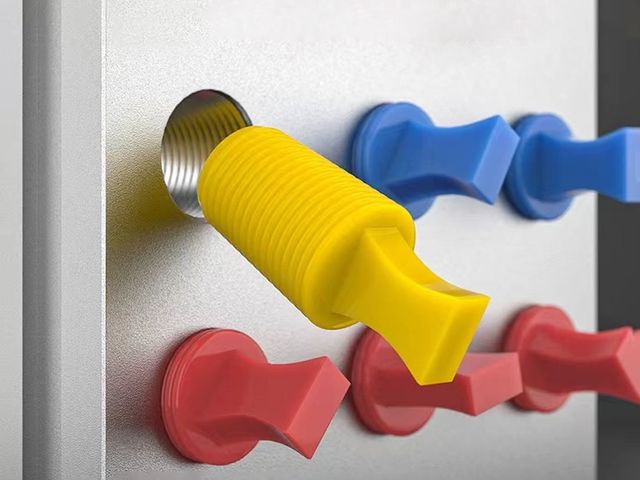
Threaded holes. The classic failure in powder coating is tape on threads. Powder creeps along the tape edge into the first thread valleys by capillary action, and the assembly department discovers it at torque time when a fastener binds or the threads gall. A tapered silicone plug seals inside the thread by compression, protecting the full depth of the thread, and pops out cleanly after cure. For most threaded holes the right answer from the silicone masking plugs range is a plug sized to the nominal thread diameter. We have compared the two approaches in detail in Silicone Plugs vs Masking Tape for Powder Coating, and the short version is: geometry gets plugs, faces get tape.
Through holes and blind holes. Through holes get a pull plug — a plug with a stem or tab that seals the bore and gives you something to grip for fast removal on a moving line. Blind holes need more care. When a sealed blind hole hits the oven, the trapped air expands as the part heats, and a plug with no way to vent will pop out, seat crooked, or lose its seal. Vented or grooved plugs solve this by giving the air a channel to escape while still shielding the thread. Measure the actual bore diameter, not the nominal size, because tapping, drilling and tolerances all move the real dimension.
Studs, bolts and threaded posts. A protruding threaded cylinder gets a cap. Caps stretch over the end of the feature and seal by elastic compression around its circumference, protecting the full length of the thread in a single push — far faster than wrapping tape around a stud, and far more reliable. They come in standard diameters, and for features that repeat they are the cheapest labour option there is.
Flange faces and sealing surfaces. A gasket face or machined flat needs a flat, even coating edge with no overspray bleed onto the face. This is tape or die-cut territory: film tape with a burnished edge gives a sharp, straight transition line, and die-cut shapes match circular or complex faces exactly. The precision comes from the burnishing — pressing the edge down so no powder can get underneath — which is why the labour term in the cost comparison matters.
Edges, slots, keyways and logos. Narrow features and fine details need fine line tape, which holds a straight edge through the cure and removes cleanly without tearing. Keyways, slots and recessed logos are exactly where a fine line or film tape outperforms both molded parts and brushed-on maskants on speed and edge quality.
Large flat areas. When a big surface has to stay bare — a machined face, a weld-prep area, a part of a panel — a sheet of film tape or a die-cut mask covers it in seconds, and the large format means the per-square-centimetre cost is very low. This is also where peelable maskants shine, because they can be brushed or dipped onto the area in one pass instead of placing individual tape strips.
Masking Materials Explained
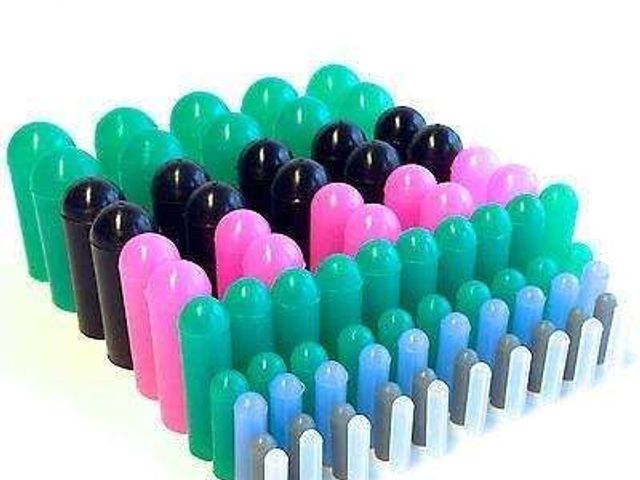
Silicone plugs and caps. Silicone is the backbone of powder-coating masking for one reason: it is rated for 260°C continuous service with short-term peaks to 315°C, comfortably above the standard cure window, and it is reusable across dozens of cycles. The material is elastic enough to seal on rough surfaces and odd tolerances, releases cleanly without leaving residue, and does not stick to cured powder. Studs, pipe ends, electrical connectors and any protruding cylinder get silicone masking caps — stretched over the feature, the cap seals by compression and comes off in one pull. Plugs and caps are molded in a range of hardness values, and the softer compounds deform into awkward bores while harder ones hold their shape in larger holes.
Polyester and PET tapes. The workhorse for flat surfaces is green or clear PET film tape, rated for continuous service around 150–180°C. It sits inside the cooler end of the standard cure window with real margin, gives a clean, sharp edge, and is inexpensive enough to use generously. For flat faces, large areas and any surface masking, polyester & PET masking tapes are the default answer of the powder industry.
Washi, crepe and fine line tapes. Paper-based tapes are lighter-duty: washi paper is rated to about 120°C and crepe to 80–120°C, which puts them below the standard powder cure. Where they earn their place is in cooler schedules — some architectural, decorative and low-temperature formulations cure below those ceilings — and in two-tone colour splits, decorative line work and fine edges that need a precise, clean line. When your process runs inside their rating, paper, washi & fine line tapes are the most economical way to get a straight edge.
Polyimide and specialty high-temperature tapes. When the process genuinely runs hot — high-bake functional coatings, stoving enamels, or unusual long-dwell schedules — polyimide film tape holds its dimensions and releases cleanly at up to 400°C peaks. The premium over PET is only worth paying when the process needs it; polyimide & specialty high-temperature tapes are the answer for the top end of the envelope, not for everyday powder work.
Liquid and peelable maskants. A brush-on or dip-on maskant is the answer to geometry that defeats every molded part and every tape shape: complex castings, internal cavities, odd profiles, and large areas where placing tape strips would take a shift. It is applied as a liquid, sets to a film, survives the cure, and is peeled off after coating. Grades are available that match the 180–200°C window and beyond. For parts that change shape or low-volume custom work, liquid & peelable maskants eliminate the need to stock a molded part for every feature.
Cost Per Part: Choosing the Right Method
The number that matters is cost per masked part, not the unit price of a plug or a roll of tape. A silicone plug costs several times more than the tape that covers the same hole once — and it is reusable across 50–100 cycles. Divide the plug price by the cycles, add a couple of seconds of application labour, and compare that against cutting, placing and burnishing tape every single cycle. On any feature that repeats daily, the plug's per-part cost drops below tape's within the first weeks. Tape wins the one-offs, prototypes and short runs where tooling a plug size makes no sense.
The labour term is the one most shops forget. Pushing a plug into a hole takes a second or two. Cutting tape, placing it, and burnishing the edge on the same hole takes ten to thirty seconds — every single cycle, on every part. Multiply that difference across a few holes, a few hundred parts and a year, and the labour saving alone buys the plug inventory several times over.
For parts that repeat with a fixed menu of features, a custom masking kit bundles the right plugs, caps and tape shapes for that one part number into a single set. It removes sorting and setup labour entirely, guarantees the line uses the correct sizes, and makes the per-part cost predictable. Kits pay for themselves fastest on assemblies with a long feature list and a steady production schedule.
Common Masking Mistakes
Using tape on threads. Tape protects the opening of a thread, not the thread itself. Powder creeps under the edge and into the thread valleys, and the failure is discovered at torque time, when it costs the most. Threads get plugs.
Choosing the wrong temperature grade. A 120°C washi tape in a 200°C cure does not fail visibly during the cycle — it fails at removal, tearing and leaving adhesive. Match the rating to the real part temperature, not the oven dial, and include headroom for rework cycles.
Skipping the burnish. Tape only seals where its edge is pressed down. An unburnished edge is an invitation for powder creep, especially on curved and vertical surfaces where the electrostatic field pulls powder sideways.
Letting masks exceed their cycle life. A silicone plug eventually loses compression and stops sealing. Retiring it on a cycle count — not waiting for the first leaking part — costs a few cents and prevents a rework that costs many times the plug.
Removing masks cold. Adhesive bonds set as the part cools. Removing masks while parts are warm-to-touch reduces residue, tearing and the temptation to reach for a scraper.
Storing masks badly. Silicone degrades under prolonged UV, heat and solvent exposure. Plugs left on a sunny windowsill or beside the oven age faster than the cycle count suggests. Store them in bins, away from heat and sunlight.
Over-masking. Features that never need protection — surfaces that are masked out of habit rather than requirement — burn labour and consumables for nothing. The audit question is simple: does this feature appear on the drawing as a critical surface? If not, it may not need masking at all.
FAQ
What is the best way to mask threaded holes before powder coating?
A tapered silicone plug sized to the nominal thread diameter, pushed in by hand until it seats by compression. It seals the full depth of the thread, survives the cure, and can be reused for dozens of cycles. Tape over the opening only protects the surface, not the thread itself.
How many times can a silicone plug be reused?
Typically 50–100 cycles, depending on the grade, the temperature of the process, and how the plug is handled and stored. Pull plugs out by the tab, keep them away from heat and UV, and retire them at the first sign of compression set — when they no longer feel firm when seated.
What temperature rating do I need for masking tape?
Rate against the actual part temperature during cure. PET film tape at 150–180°C continuous covers the cooler end of the standard 180–200°C window; for parts running at the top of the window, choose a grade rated at 180°C or step up to polyimide, which handles 400°C peaks. Paper tapes at 80–120°C are for cooler schedules only.
Peelable maskant or tape — which should I use?
Use tape where you need a defined, straight edge on a flat or regular surface. Use a peelable maskant where geometry makes tape application slow — irregular shapes, internal cavities, and large areas where placing strips would take more time than brushing or dipping.
How do I calculate masking cost per part?
Take the material cost divided by its usable cycles (for a plug) or the material used per application (for tape), then add application and removal labour per part. Compare methods on that per-part number, not on unit price. On any feature that repeats, reusable silicone wins on labour alone within the first few weeks.
Masking choices multiply across thousands of parts, and the difference between a good and a bad specification shows up on the production floor, not in the catalogue. If you are setting up a new line or auditing an existing one, send us your part drawing or a list of features to mask — our engineers will recommend the right plugs, caps, tapes and, where it makes sense, a custom kit, and send samples for your first run. Contact LeaderMasking for a sample kit or a quote.