Sandblasting masking is the practice of covering threads, machined surfaces, tapped holes, and critical dimensions with abrasion-resistant tape or plugs so that blast media — most commonly aluminum oxide (typically 16–240 mesh), glass bead (typically 40–170 mesh), and steel grit — cannot erode, peen, or contaminate them during surface preparation. Blast media is accelerated to high velocity and behaves like a low-grade cutting tool: each angular particle that strikes an unprotected surface removes a measurable amount of material, rounds off sharp edges, and embeds fragments into the substrate. Abrasive blasting for a typical structural steel profile can be carried out at 80–100 psi nozzle pressure, and even a short exposure to 120 mesh aluminum oxide will cut through a thin PVC film that was never designed for impact wear. The protective materials used for this job differ from paint or plating masking in one decisive way: they must survive particle impact and edge erosion, not just chemical exposure or moderate heat. That is why sandblasting masking is specified from a dedicated class of products — vinyl film tape, rubber-backed cloth tape, reinforced cloth tape, fiberglass cloth tape, and high-temperature silicone plugs — each rated for blast exposure and, in many cases, for the cure temperatures that follow in a powder coating oven.
Why Sandblasting Destroys Ordinary Tape
Standard painter's tape, polyethylene film, and thin PVC masking tapes fail under blast media for a mechanical reason. A blast stream is not uniform pressure; it is a continuous spray of hard particles moving at roughly 50–70 m/s at the nozzle, each one carrying kinetic energy proportional to its mass and the square of its velocity. When aluminum oxide or steel grit strikes the surface of a tape, the impact point experiences localized stress far higher than the tape's tensile or tear strength. The result is a sequence of predictable failures:
- Abrasion through the film. Soft films erode progressively. A 50-micron PVC film can be worn through in seconds of direct exposure to coarse grit, leaving the protected surface underneath exposed to the blast stream.
- Edge lifting and curling. Blast particles wedge under the cut edge of a tape, peel it back, and then blast media works beneath the lifting edge. Once a tape edge lifts, the adhesive picks up dust and grit, loses its bond, and the entire strip becomes a funnel that directs particles onto the surface it was supposed to protect.
- Adhesive breakdown from impact. Aggressive media hammers the tape backing, flexing it thousands of times per second. Flexible adhesives fatigue, and embedded particles turn the adhesive layer into an abrasive slurry that grinds the substrate.
- Tearing at transitions. Where a tape bridges a corner, a weld seam, or a threaded shoulder, the backing is unsupported. Blast impact on an unsupported span tears the film almost immediately.
The practical consequence is that masking for blasting has to be chosen by abrasion resistance first, temperature rating second, and adhesive strength third. A tape that survives 180°C in an oven but erodes in 30 seconds of blasting is worse than useless — it fails in the middle of the process and forces a rework. This is the core reason the sandblasting media blasting tape category exists as a separate product family from standard powder coating or painting masks.
Tape Selection: Four Materials, Four Job Profiles
PVC Film Tape (60–80°C)
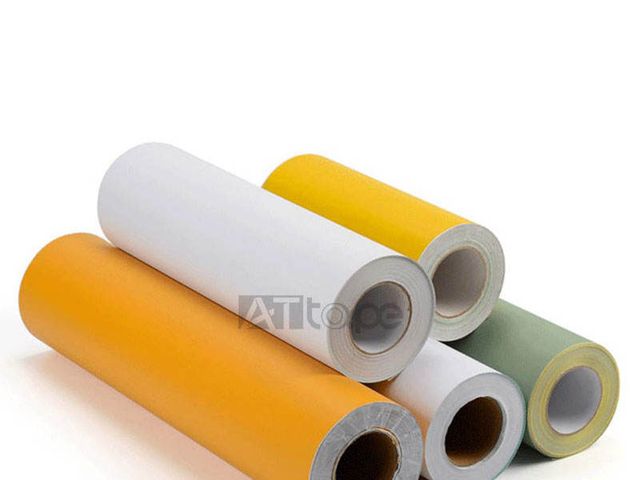
PVC film blasting tape is the light-duty option. Its low cost, clean die-cutting, and smooth surface make it the default for short blast cycles, fine media like glass bead or fine aluminum oxide, and surfaces that will not be exposed to a subsequent high-temperature cure. The working limit is roughly 60–80°C continuous, which is fine for a room-temperature blast operation but rules it out for parts that go straight into a powder coating oven after blasting. Use it where blast time is short, media is fine, and you need a cheap, residue-clean film. For a closer look at the specification, see the vinyl blasting tape page and the yellow PVC film blasting tape version.
Rubber-Backed Cloth Tape (~150°C continuous)
Rubber-backed cloth tape is the workhorse of sandblasting masking. The cloth backing absorbs and dissipates impact energy far better than a polymer film, and the rubber adhesive provides aggressive initial tack on rough or lightly rusted steel. Its temperature ceiling — roughly 150°C continuous — covers most blasting, cleaning, and degreasing operations and sits just under a standard powder coating cure range, so confirm the bake schedule before using it under the final coat. The combination of tear resistance and conformability makes it the best general-purpose choice for masking flat areas, seams, and the perimeter of threaded fittings. See the rubber-backed cloth blasting tape product page for widths and roll options.
Reinforced Cloth Tape
When blast exposure is heavy — coarse steel grit, long cycle times, or repeat passes — reinforced cloth tape adds a scrim or fiber layer inside the cloth backing that dramatically improves puncture and tear resistance. It holds an edge much longer under direct impact, which matters when you are masking large panels or flange faces that sit in the direct blast path. It also resists the edge-lift failure mode described above, because the reinforcement anchors the cut edge and stops the curling that lets particles get underneath. Reinforced cloth tape is the right specification for abrasive blasting of heavy fabrications where PVC or plain rubber-backed cloth would not survive the cycle. The reinforced cloth blasting tape page lists the available constructions.
High-Temperature Fiberglass Cloth Tape (260–400°C)
Fiberglass cloth tape is the crossover product for the two-stage process that is common in industrial finishing: blast the part, then powder coat it in the same mask. Because powder coating cures at roughly 180–200°C, the mask has to survive both the abrasion of blasting and the heat of the oven. Fiberglass cloth tape, with a working range of roughly 260–400°C depending on construction, clears that bake easily while still providing a dense, abrasion-resistant weave that shrugs off blast media. If a job requires one mask through blasting and through cure, this is the tape that eliminates the second masking operation. It is also the product to reach for when post-blast heat treatment, adhesive bonding, or other elevated-temperature processes follow. The high-temperature fiberglass cloth blasting tape product page has the full temperature data.
Plugs and Caps: Protecting Threads and Holes
Tape protects flat and gently curved surfaces, but it does a poor job on threaded studs, tapped holes, and blind bores. A thread is exactly the geometry blast media attacks most efficiently: the angular particles strike the crest of each thread, round it off, and then pack debris into the root. A single pass of coarse grit over an unprotected M12 stud can reduce the effective thread profile enough to affect fit. Threads and holes need positive plugging, not surface adhesion.
High-temperature silicone plugs are the standard solution. A silicone plug inserted into a tapped hole or pressed over a threaded stud forms a positive mechanical seal that blast media cannot displace, and silicone's elasticity lets one plug size accommodate a small range of thread diameters and hole sizes. Because the plugs are rated for high service temperatures, they survive the powder coating cure step as well as the blast step, so they can stay in place through the entire finishing sequence. This makes them the answer to the recurring production question of how to keep media out of threads without taping over every stud individually. The high-temperature silicone masking plug is the product to specify for threaded holes and studs on parts that will be blasted and then coated.
The same principle applies to holes that must remain open for fastener fit. A plug pressed into a bore stops media from eroding the hole wall and keeps grit from lodging in the bottom of a blind hole, where it would later contaminate the part or the assembly line. For through-holes, plug both ends, or plug one end and rely on the media being stopped by the plug body. When you order plugs, size them against the actual drilled hole diameter, not the nominal thread size, because the seal depends on a slight interference fit.
Masking Large Areas Efficiently
Blasting a whole fabrication with only a few protected regions calls for a different tactic than masking one small flange. On large panels, tank ends, or structural sections, the goal is to cover as much area as possible per minute of labor while keeping the mask anchored against the blast stream. Two practices matter:
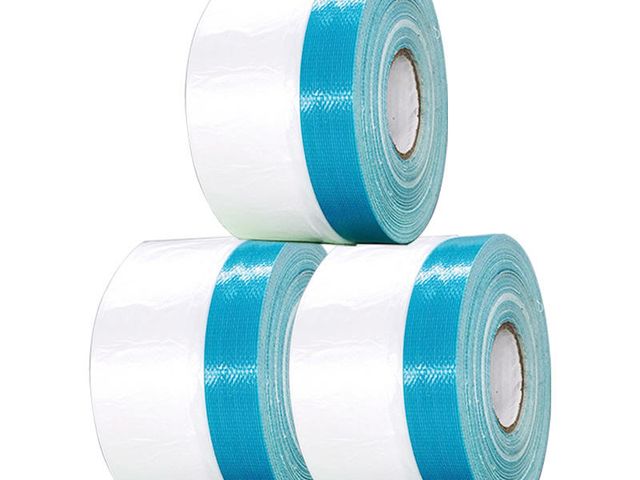
- Use wide rolls. A 48 mm or wider rubber-backed or reinforced cloth tape covers flat runs in fewer strips, and fewer seams means fewer edge-lift points for blast media to attack. The product category page lists the available widths across the blasting tape range.
- Press edges down hard. The adhesive bond at the leading edge of each strip is what stops particles from lifting the tape. Burnish the full edge with a roller or a squeegee, and lap strips by at least 10 mm where they overlap, orienting laps so the blast stream does not have a lip to catch.
For masking jobs that combine large flat areas and threaded details, use cloth tape for the surface and plugs for the features, rather than trying to stretch a single product across both jobs. Mixing materials by function — film or cloth tape for area coverage, reinforced tape for heavy blast zones, plugs for holes and threads — is how job shops get one consistent mask that survives the full cycle without rework.
Removal After Blasting
Abrasive blasting is a dusty, energetic process, and masking that is left on the part through the blast cycle has been pounded with particles and often baked if a cure follows. Removal is where many shops discover whether their tape choice was correct. The failure modes are torn residue and adhesive smear, and they are largely preventable:
- Remove tape promptly. The longer a mask sits on the part, the more the adhesive crosslinks or sets against the surface. Pull tape within the same shift if possible, at a 180° angle back over itself rather than straight up, which concentrates peel stress on the adhesive-substrate interface and minimizes transfer.
- Avoid excess heat before removal. If the tape must survive a powder coating cure, remove it after the part cools but before the adhesive has fully hardened. Rubber adhesives in particular are easier to strip warm; letting the part cool completely to room temperature first is not always the right call for rubber-backed cloth.
- Choose the right adhesive for the surface. A rubber-based adhesive with high initial tack holds through the blast cycle but can be harder to remove from a smooth, bare surface than a cleaner-peeling synthetic adhesive. Match removal characteristics to the finish. If residue is a recurring problem on a particular product line, review the guidance in our article on how to prevent adhesive residue after cure.
- Remove plugs by the stem, not the body. Silicone plugs should be pulled straight out with a firm, even tug. Twisting or rocking a plug can leave a silicone smear in a tight thread root that is difficult to clean.
Any embedded media on the adhesive side is a signal the mask was removed too late, the tape was underspecified for the blast pressure, or the adhesive picked up grit at the edge before lifting. All three are correctable with the right product and removal timing.
Sandblasting Masking Materials Compared
Use the table as a first-pass selector: match the highest temperature step in your process first (blast temperature is essentially ambient, so the cure step usually dominates), then match abrasion resistance to the coarsest media and longest cycle time in your schedule.
Frequently Asked Questions
What tape do you use for sandblasting?
For general sandblasting masking, use a rubber-backed cloth tape rated around 150°C continuous — it survives impact from common media and conforms to seams and flanges. For light-duty jobs with fine media such as glass bead, a PVC film tape (60–80°C) is cheaper and removes cleanly. If the part is blasted and then powder coated, step up to a high-temperature fiberglass cloth tape that survives both the blast cycle and the 180–200°C cure. Browse the sandblasting masking category to compare the full range.
Can silicone plugs survive sandblasting?
Yes. Silicone masking plugs survive sandblasting because they form a positive mechanical seal rather than a surface bond. Blast media strikes the plug body and deflects, and because the plug is pressed into the hole or over the stud, there is no edge for particles to lift. High-temperature silicone plugs also survive the subsequent powder coating bake, so they can remain in place through the entire blast-and-cure sequence.
Does masking tape stop blast media from hitting threads?
Only if it stays bonded, and tape alone is the weak choice for threads. Tape over a thread can be lifted at its edge and blasted off, and even if it holds, it does not protect the thread root geometry well. Plugs are the reliable answer for threads: a high-temperature silicone plug pressed over a stud or into a tapped hole keeps media off the thread profile entirely and survives the cure step that follows.
What is the best way to mask a hole for sandblasting?
Insert a silicone plug sized for a slight interference fit against the actual hole diameter. For a blind hole, plug the open end; for a through-hole, plug both ends. Press the plug in firmly so the blast stream cannot work around its perimeter, and leave it in place through any oven cure. Do not rely on tape stretched over the mouth of a hole — the unsupported span will tear or blow off under direct blast impact.
How do you remove blast tape without residue?
Peel tape back over itself at a 180° angle while the part is still warm but safe to handle, rather than pulling straight up. Remove it promptly after the blast cycle or after the part cools from the oven, before the adhesive fully sets. Choose a tape whose adhesive system matches the surface — rubber-based for rough steel where high tack matters, a cleaner-peeling film where residue has been a problem. If residue still appears, review our guide to preventing adhesive residue after cure.
Getting the Right Masking for Your Blast Operation
Sandblasting masking is a materials decision before it is a labor decision. A tape or plug that survives the blast cycle saves the cost of rework, the cost of rejected threads, and the labor of re-masking parts that failed mid-process. The practical selection rule is simple: match the mask to the coarsest media, the longest cycle, and the highest-temperature step in your process, and use plugs for every hole and thread rather than asking tape to do a job it is not built for. If your parts need custom widths for large-area coverage, plugs sized to non-standard bores, or a mask that must survive both blasting and a high-temperature cure, contact LeaderMasking with your part drawings and process details — we can supply the right tape and plug combination for your specific blast media and cycle, in the sizes your line actually runs.